

Malacca (Melaka) is one of the oldest states of Malaysia, and owing to its colorful beauty and history, it holds the attention of tourists. For example, its prime location on the Strait of Malacca, one of the busiest sea trade routes in the world, has sustained its position as a center for trade, culture and power.
 Early History and Founding
The history of Malacca is the 15th century CE. Legend has it that the sultanate was established by Parameswara, a Sumatran Hindu prince driven to the Malay Peninsula after defeat by the Siamese. He took up abode in the area, and the city served as the Trading Port.
However, the attainment of the power of Malacca in 1400 is marked by the conversion of Parameswara to Islam, taking the title of Sultan Iskandar Shah. As its paramount, Malacca became a busy, respectable commercial center where traders from China, India and the Islamic world arrived. The city-state then became one of the key seaports in the southeast region of Asia as the result of location advantage and the establishment of the Malacca Sultanate.
The Malacca Sultanate
The Malacca Sultanate enjoyed its greatest economic prosperity when a succession of sultans, particularly Sultan Mansur Shah (1456–1477) and Sultan Mahmud Shah (1488–1511), ruled. Maritime strength in Malacca thrived during this period, and the state retained significant practical control over local trade. It also generated a mixed inheritance of Malay culture and Islam, as well as a locally developed and practiced mixture of Indigenous cultural and pastoral values and practices that yielded its unique status as a cultural and religious center.
At this time, Malacca also established close diplomatic and economic ties with mighty external powers, such as the nations of China, Portugal, and the Netherlands. The town gained world prominence as the cultural home for an ethnically rich multicultural community of Malays, Arabs, Chinese, Indians and other ethnicities.
The Portuguese and Dutch Colonial Periods
The year 1511 saw the Portuguese, led by Alfonso de Albuquerque, capture Malacca in a brief siege, resulting in the development of the European settlements in the region. For more than a century, the Portuguese held Malacca and used it not only as a key point for their trade and missions but also as a base for occupation. With the forts they built in the land, the Portuguese carried the religion of Catholicism with them, and so, to a great extent, this last day of them in the land.
The Dutch East India Company took possession of Malacca in 1641 after centuries of Portuguese withdrawal. The Dutch ultimately ruled the region for over 150 years, accumulating trade monopolies, mainly in the form of spices but also in many other valuable items. Nevertheless, at this stage, Malacca’s position as the principal trading center receded. In contrast, new trading centers, such as Penang and Singapore, entered the picture and took on a more dominant role.
British Rule and the Road to Independence
By the late 18th century, Malacca had come within the orbit of British authority through the Anglo-Dutch Treaty (1824), which aimed to partition the area of influence between the Dutch and the British. The British administered Malacca as part of the Straits Settlements, along with Penang and Singapore. Malacca served as the headquarters for commercial, administrative and military affairs.
Malacca played a significant part in British Malaya until the country’s independence in 1957. The city played an essential role in the nationalist movement through the presence of numerous political activists and extraordinary moments of political activity that, in turn, strengthened the movement for independence.
Malacca Today
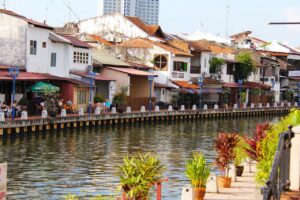
Today, the town of Malacca is a site of UNESCO heritage due to its historical significance, the quality of its extant structures and its cultural significance. A town that attracts hundreds of millions of visitors every year, each of whom is a potential visitor to its colonial architecture, temple complexes, museums and street scenes. Examples of tourist spots. Web sites, e.g., the A Famosa fortress, St. Paul’s Hill and Jonker Street, etc.
Malacca is a cultural city yet to this day, and it still shows us the impact of multiple ethnic and religious communities on its history. Nowadays, the city can be characterized as blending all these traditions into a combination of Malay, Chinese, Portuguese, and Dutch, which has produced a new mix.
Conclusion
The history of Malacca is a chronicle of transformation from a small trading enclave to a thriving maritime sultanate and, during the era of European colonialism, to a modern living cultural tapestry. Among the most important factors relevant to the process of building the Malaysian national identity is its historical value, that is, as a significant constituent of the national patrimony.